Fifteen pieces of generative art
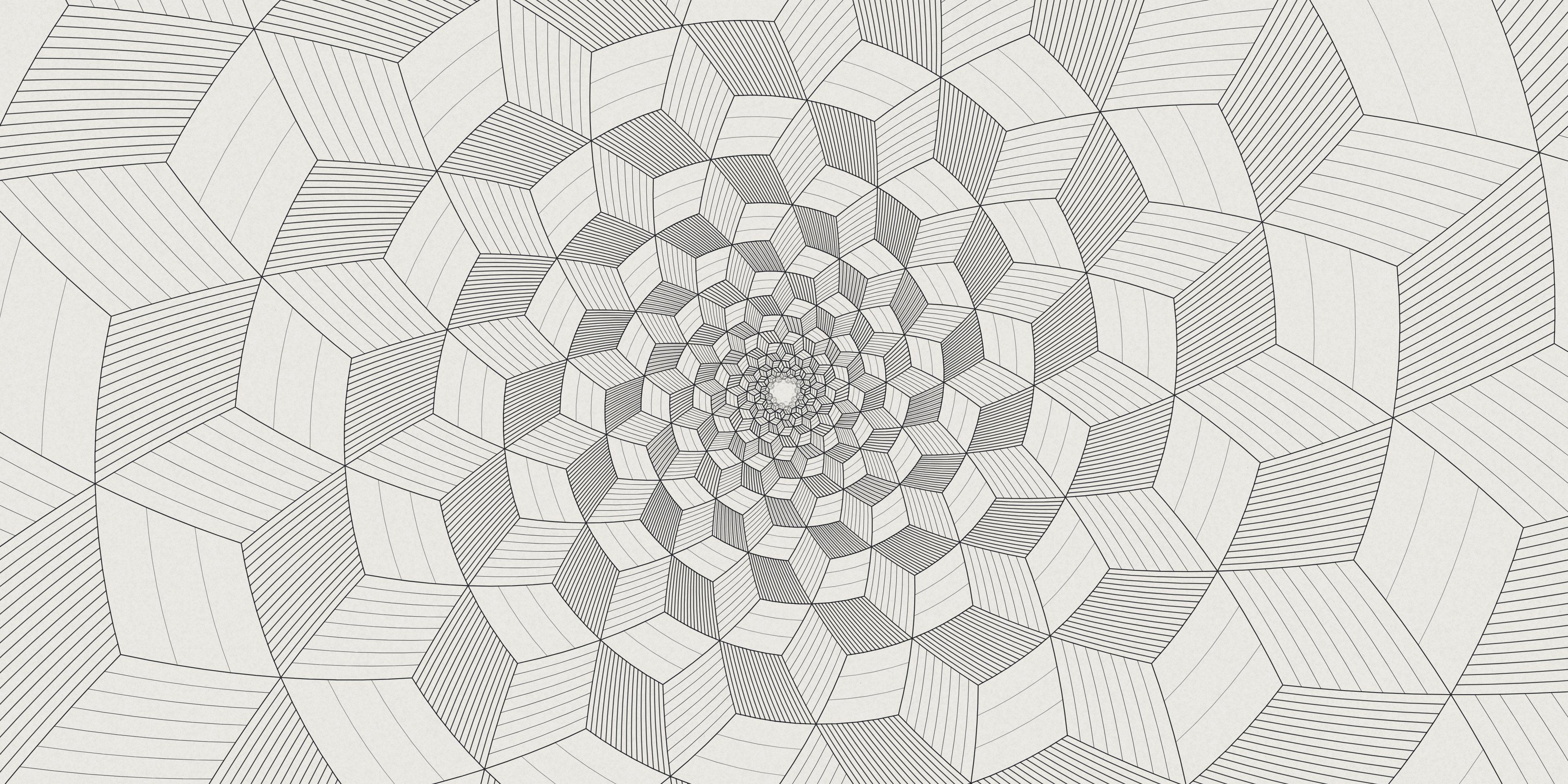
I wanted to play around with some generative abstract art. A short side project with Claude agents left me with a small engine and fifteen pieces that are drawn live in your browser.
Generative artwork.
Listen to this note
7 minutes · two hosts talk it through
Chapters
Transcript
AlexThis is the audio version of a Field Notes piece by Martijn Hermans, about fifteen pieces of generative art that Claude agents built for him.
SamI'm Sam.
AlexAnd I'm Alex. We're both synthetic voices. The script was written by an AI from Martijn's article, and voiced with PodcastD, the podcast tool he builds himself.
SamIf you have the article open, keep it open. The pictures are the point, and we'll talk alongside them.
AlexIt starts with a question. He had seen some generative AI art lately, and it got him wondering. Could Claude agents build the kind of drawing he loved as a child?
SamAnd could he steer them to something he would want to look at for more than a minute.
AlexFifteen of them did. Each is a few lines of mathematics, drawn live in your browser. Hairlines on grey paper, in the manner of early plotter art.
SamAnd nothing on that page is a video. It is being drawn while you look at it.
AlexSo what was the drawing he loved as a child?
SamForm drawing, at the school he went to. Mostly it was geometry class with a compass. There were also forms like one continuous line looping around itself. Lying eights. Interlaced strands. Circles overlapping, six around one.
AlexThat is already a rule, really. Put the point here, swing the pencil, repeat.
SamHe never gets round to drawing like that anymore. Now he can build something like it digitally, in a matter of hours.
AlexThe other thing he was looking at was artists who made pictures from rules and a little chance. Most did it with computers, many on a plotter, in the nineteen sixties and seventies. Vera Molnár, Georg Nees, Frieder Nake, and others. Casey Reas later, with software.
SamAnd some did it by hand. From nineteen sixty, François Morellet marked or skipped the squares of a grid by the even and odd digits of a phone book.
AlexSo the phone book is the chance, and the grid is the rule.
SamExactly. And M.C. Escher, also by hand, for his tessellations, the Droste effect and impossible cubes.
AlexOkay, newcomer question. What does "a few lines of mathematics" actually mean here?
SamIt means each piece is one rule you could write down. Take the one called pegs and string. A string goes from each peg to the peg at k times its number.
AlexAnd k is just a number.
SamA number that keeps sliding. As k sweeps, the curves bloom and fold into one another. You don't draw those curves. They appear out of all the straight strings together.
AlexThat's the trick, then. Simple rule, a lot of repetition.
SamThe roulette rosette works the same way. One curve, the kind a gear traces rolling inside a ring, drawn about ninety times. Each copy offset and turned a little further.
AlexAnd where the copies overlap you get those moire rosettes.
SamRight. Each piece has one plain line with its defining equation. If you're curious, open The mathematics under the picture.
AlexAnd if you want a closer look, hover over a piece and choose Enlarge.
SamSo why is a rule plus a little chance worth looking at? The style spec puts it plainly. Order versus disorder is the drama.
AlexThe style spec being?
SamA single Markdown file the agents worked from. It opens with taste principles. One rule, stated plainly. If a piece can't be described in one sentence, cut until it can.
AlexAnd chance?
SamRandomness is seasoning on a system, never the system.
AlexYou can see that in the grid of squares on the page. Order and disorder trade places, in patches that drift across the sheet.
SamTwo more principles. Texture completes the image: a grain-free render is unfinished. And always moving, never repeating. A piece that holds still reads as broken, not calm.
AlexHow do the agents fit together?
SamEvery piece sits on one small shared engine. The engine draws the paper and the grain and runs the loop. Each builder agent got a brief that pointed to the spec and described its one piece.
AlexSo the paper is shared, and each drawing is its own little file on top.
SamThat's it. And the bill? Nothing was paid per token. It all ran on his Claude subscription plan. The list-price equivalent is about seventy dollars, and that's a lower bound.
AlexNow the part that surprised him. Everything so far came out of Claude in the cloud. So he gave the same job to two models running on his own server.
SamQwen three point eight Flash Next, the big one. And the smaller Qwen three point eight twenty-seven B, on two graphics cards.
AlexWhat did he give Flash Next?
SamThe whole job in one go, for that drifting grid of squares. No engine, no feedback. So it had to draw the paper, the grain and the page itself.
AlexAnd?
SamIt worked four times out of four.
AlexWith thinking switched off, though, it didn't. His first attempts stopped after about four thousand tokens, with a solid or static page.
SamThen he asked it to write the engine too, the shared file under every piece. On its second attempt, its engine ran three of Claude's pieces.
AlexSo a model at home wrote an engine that could carry Claude's work.
SamThe comparisons are on the page, side by side. There's a Tesseract from Flash Next that failed his automatic ink check, with too little of the page inked. But he likes the page.
AlexThe smaller model needed more help. Given the whole job in one go, only one of six jobs passed the checks. Given the engine, it got four out of four.
SamFor the roulette, it drew a clean ring, then ran ten rounds of critiquing its own screenshots and rewriting the file. No notes from Martijn.
AlexAnd the sunflower spiral, if you scroll down. That one is his favorite of the models he ran at home. Surprisingly cool, he says.
SamIt was weaker at taking corrections. He asked it to slow the sunflower down to zero point two times its speed. It got to zero point seven times.
AlexAnd with thinking on, it spent all forty thousand tokens reasoning and returned no code.
SamSo where does it stand?
AlexFifteen pieces, all live, each a few lines of mathematics.
SamThe follow-up he would like to do is a real-life viewer. An ESP thirty-two with an e-ink screen, run at a high, unlocked frame rate, so the pieces keep moving instead of turning into a static image.
AlexWhether an ESP thirty-two and an e-ink panel can keep up is the open question.
SamUntil then, they're on the page in front of you, still moving.
AlexThanks for listening.
Made with PodcastD, the in-house tool I build for turning writing into podcasts. Claude wrote the script from this note; the voices are synthetic (Kokoro (am_michael, af_sarah)) and everything was rendered on my own machine.
I had seen some generative AI art lately, and it got me wondering: could Claude agents build the kind of drawing I loved as a child, and could I steer them to something I would want to look at for more than a minute? Fifteen of them did. Each is a few lines of mathematics, drawn live in your browser.
They are hairlines on grey paper, in the manner of early plotter art. Nothing below is a video.
What I was looking at
As a child I loved vormtekenen, the form drawing we did at the vrijeschool I went to. Mostly it was geometry class with a compass (a passer). There were also forms like one continuous line looping around itself, lying eights, interlaced strands and circles overlapping six around one. I never get round to drawing like that anymore. Now I can build something like it digitally in a matter of hours.
Then the artists who made pictures from rules and a little chance. Most of them did it with computers, many on a plotter: Vera Molnár, Georg Nees, Frieder Nake, Manfred Mohr, Charles Csuri and Ruth Leavitt in the 1960s and 70s, and Casey Reas later with software. François Morellet did it by hand: from 1960 he marked or skipped the squares of a grid by the even and odd digits of a phone book. And M.C. Escher, also by hand, for his tessellations, the Droste effect and impossible cubes.
Built from straight lines
Hover over a piece and choose Enlarge to see it bigger.
Pegs and string
A string from each peg to the peg at k times its number. As k sweeps, the envelope curves bloom and fold into one another.
The mathematics
chord from peg i to peg (k * i) mod N for every peg i; k sweeps continuously from 2 up to 2 + range and back, lingering near whole numbers (cardioid at 2, nephroid at 3, then 3, 4 and 5 cusps) What moves: the multiplier k sweeps slowly, so the envelope curves (cardioid, nephroid and more) bloom and fold into one another.
Tesseract
A hypercube turning in four dimensions, drawn as a fan of fine lines. Only some of its edges are inked.
The mathematics
16 vertices (+-1)^4 and the 32 edges between vertices that differ in one coordinate. Turn by R_xw(a) R_zw(2a), so the two planes turn at 1:2; project with x' = x * d / (d - w), d = 6. Only the edges of a seeded half of the 24 square faces are drawn, and 12 echoes of the cube are drawn at small turn offsets. What moves: both rotations, the spacing of the echoes and the eye distance.
Schotter drift
Order and disorder trade places in a lattice of squares, in patches that drift across the sheet.
The mathematics
A lattice of about 430 squares. Each square i gets a disorder A_i between 0 and 1 from a smoothed sum of travelling plane waves, then angle_i = A_i * 0.18 rad * r_i and offset_i = A_i * 0.55 pitch * (r'_i, r''_i), with r fixed random numbers in [-1, 1]. Slow rings of order cross the sheet. What moves: the waves, so patches of order and disorder drift; some squares open into nested ones.
One curve, copied and turned
Ribbon sheaf
One looping curve copied a few hundred times, each copy turned a little further, until the hairlines read as a folded ribbon.
The mathematics
Base curve (sin(f1 s + p1), sin(f2 s + p2), sin(f3 s + p3)), s in [0, 2 pi), with (f1, f2, f3) one of (1,2,1), (2,3,1), (1,3,2), (2,1,3), (3,2,1) chosen by the seed. Copy u in [0, 1] of 240 is turned by (u - 0.5) * sweep about one axis and by (u - 0.5) * twist in the picture plane; sweep and twist are about 1.3 rad. What moves: sweep, twist and the depth phase breathe, and the sheaf slides one copy step per loop.
Roulette rosette
A hypotrochoid drawn ninety times, each copy offset and turned a little further, weaving moire rosettes.
The mathematics
x = (R-r) cos u + d cos(((R-r)/r) u), y = (R-r) sin u - d sin(((R-r)/r) u), R/r = a/b rational; d stepped per copy What moves: the pen offset d breathes and the set of copies advances.
Roos
One rose curve copied about forty times, each copy smaller and slimmer, while k slides between rational values.
The mathematics
r = cos(k t), t in [0, 4 pi), k = p/q in {5/2, 4}, blended in polar form r = (1-L) r_a + L r_b; copy j: scale 1 - 0.92 j/N, turn j d, petal exponent 1 + 0.9 j/N What moves: k slides between rational values.
Oscillation and flow
Thomas attractor
Hairline filaments flow along one strange attractor while a single damping parameter drifts and the scroll folds into new shapes.
The mathematics
dx/dt = sin y - b x, dy/dt = sin z - b y, dz/dt = sin x - b z; b drifts between 0.1846 and 0.1878 What moves: the damping b drifts slowly, so the scroll folds into new shapes.
Chladni figure
The standing waves of a square plate. Sand gathers on the lines that stay still while two modes cross-fade.
The mathematics
u = cos t (cos n pi x cos m pi y - cos m pi x cos n pi y) + sin t (same with n', m'); sand on u = 0, contours at u = +-0.15, +-0.3 What moves: two vibration modes cross-fade, so the sand lines migrate.
Harmonograph
One closed pen path from four pendulums. The ink gathers where the path retraces itself.
The mathematics
x(u) = Σ A_i sin(f_i u + φ_i) m_i(u), y(u) likewise; f_i = a_i N + e_i integers, m_i(u) = 0.55 + 0.45 cos(k_i u + ψ_i), u in [0, 2π] What moves: an amplitude envelope winds the spiral in and out, and the ink gathers where the path retraces.
Tilings
Metamorphosis
Hatched and empty tiles that interlock without gaps and drift sideways, changing their edge curves as they cross the page.
The mathematics
Square tiles whose edges are curves e(s) = sum over k = 1..4 of a_k sin(k pi s), zero at both ends so neighbours always meet. Motif A blends into motif B with m(x) = smootherstep(1/2 - 1/2 cos 2 pi (x/W - p)), and each shared edge is evaluated at its own x, so both tiles use the same curve. Alternate tiles are hatched. What moves: the morph front crosses the sheet and the whole lattice drifts sideways by 8 columns per loop.
Penrose phason drift
A Penrose tiling from a pentagrid whose lines slide, so tiles flip in place and the pattern stays Penrose.
The mathematics
x.e_j + g_j in Z, e_j = (cos 2pi j/5, sin 2pi j/5), sum g_j = 0; rhomb vertices sum_m K_m e_m, K_m = ceil(x.e_m + g_m); g_j = g0_j + A cos(theta + 4 pi j/5) What moves: the pentagrid lines slide, so tiles flip in place and the pattern stays a Penrose tiling.
Kubus Kubusstapeling
A heap of isometric cubes drawn as rhombi. Cubes come and go one at a time, building towers and canyons.
The mathematics
h(i,j) in 0..n, h(i,j) >= h(i+1,j), h(i,j) >= h(i,j+1); the hexagon n x n x n is tiled by 3n^2 rhombi; a flip of three rhombi adds or removes one cube What moves: cubes are added and removed one at a time, so the heap grows and collapses.
Smaller and smaller
Hyperbolic tiling
A regular tiling of the hyperbolic plane in the Poincare disc, swimming like a fisheye as a Mobius shift moves it.
The mathematics
{p,q} tiling of the Poincare disc; geodesics are circle arcs orthogonal to |z|=1; z -> (z + a)/(1 + conj(a) z), a(theta) a closed orbit What moves: a moving Mobius shift makes the whole tiling swim like a fisheye.
Apollonian gasket
Tangent circles packed by Descartes' theorem, swirled by a map that keeps every tangency exact.
The mathematics
k4 = k1 + k2 + k3 +- 2 sqrt(k1k2 + k2k3 + k3k1); circles move by z -> (z - a)/(1 - conj(a) z), a(theta) a closed orbit What moves: a Mobius map swirls the packing and keeps every tangency.
Droste Spiraal in zichzelf
Pencil-hatched cubes wound into a logarithmic spiral that contains a smaller copy of itself and zooms inward.
The mathematics
z = exp(w), w = G (u1 + rho u2), G = 2 pi i / (n1 + n2 rho); the cube pattern is periodic in u, shifted by tau (k1,k2), tau = t/T, so tau = 1 is the identity What moves: the spiral zooms endlessly inward.
The prompts
The agents worked from a style spec, a single Markdown file, and every piece sits on one small shared engine that draws the paper and grain and runs the loop. The spec opens with the taste principles. Some of them, word for word:
Style spec, taste principles (excerpt)
1. One rule, stated plainly. Every piece can be described in one sentence (“a grid of squares that loses its order row by row”). If it cannot, cut until it can.
2. Order versus disorder is the drama. Randomness is seasoning on a system, never the system.
3. Texture completes the image. Paper grain, ink density, and line overlap do the work that colour does elsewhere. A grain-free render is unfinished.
5. Always moving, never repeating. […] A piece that holds still reads as broken, not calm.
9. Banned look: soft gradient blobs, glow, bloom, chromatic aberration, neon or purple gradients, glassy 3D, drop shadows on UI, rounded “card” frames, particle confetti, and any coloured accent strip on a left edge.
Each builder then got a brief that pointed to the spec and described its piece. One paragraph from the roulette brief:
Builder brief (excerpt)
M09 Roulette rosette: hypotrochoid x=(R-r)cos u + d cos(((R-r)/r)u), y=(R-r)sin u - d sin(((R-r)/r)u), rational R/r, about 90 copies with d stepped or rotated per copy; moire rosettes. Live: R/r and d wander through nearby rational values smoothly, copies rotate at different rates, an accent copy sweeps through the set. Each gets meta.math (one plain-text line with the defining equation, for article captions), meta.label (one sentence), meta.start, still, T in {8, 12, 16} and params.Models and tokens
The tokens the sub-agents used, summed from their transcripts (measured). Most of what they read came from cache, which is why cache reads dwarf the other columns.
| Role | Model | Agents | Input | Output | Cache reads | Cache writes | At list prices |
|---|---|---|---|---|---|---|---|
| Style spec writer | Claude Opus 5.5 | 1 | 48 | 23,767 | 1,899,719 | 98,515 | $1.35 |
| Piece builders | Claude Sonnet 5.5 | 14 | 2,758 | 1,765,982 | 264,485,534 | 7,607,847 | $63.13 |
| Local-model experiment driver | Claude Sonnet 5.5 | 2 | 312 | 99,244 | 21,470,167 | 1,014,896 | $5.68 |
| Total at list prices, a lower bound. Not what I paid. | $70.16 | ||||||
I did not pay the $70.16. Nothing here was paid per token: it all ran on my Claude Ultra Plan. The total is only what the same tokens would cost at list prices.
Priced at Anthropic’s list prices of 3 November 2026: Opus 5.5 at $4 per million input tokens and $20 output, Sonnet 5.5 at $2 and $10, plus the cache rates. The session I ran it from is not logged, so the total is a lower bound.
Could a model on my own machine do this?
Everything above came out of Claude in the cloud. So I gave the same job to two models running on my own server: Qwen 3.8 Flash Next, a 125-billion-parameter model that runs partly from RAM, and the smaller Qwen 3.8 27B on two graphics cards.
Qwen 3.8 Flash Next
Flash Next is the big one, and it surprised me. I gave it the whole Schotter job in one go, with no engine and no feedback, so it had to draw the paper, the grain and the page itself. It worked four times out of four. (With thinking switched off it did not: my first attempts stopped after about 4,000 tokens with a solid or static page.)
Schotter drift
Claude Sonnet 5.5
Built by a Claude agent from the same brief.
Qwen 3.8 Flash Next, whole page, no engine
First of four tries, not the best one.
Then I asked it to write the engine too, the shared file under every piece. Its second attempt ran Claude’s Schotter, Ribbon sheaf and Roulette. Same piece, two engines:
Schotter drift, same piece, two engines
On Claude's engine
The piece as it appears above.
On Flash Next's engine
The same piece file, built with the engine Flash Next wrote.
After that I went back to Claude’s engine and Claude’s exact prompts, so only the piece file was Flash Next’s. It never saw Claude’s version of the piece it was building.
Schotter drift
Claude Sonnet 5.5
Built by a Claude agent from the same brief.
Qwen 3.8 Flash Next, same prompt as Claude
Squares with smaller squares inside, loosely scattered across the page.
Tesseract
Claude Sonnet 5.5
Built by a Claude agent from the same brief.
Qwen 3.8 Flash Next, same prompt as Claude
It failed my automatic ink check (2.6% of the page inked, the check wants 3 to 40%), but I like the page.
Ribbon sheaf
Claude Sonnet 5.5
Built by a Claude agent from the same brief.
Qwen 3.8 Flash Next, first attempt
First try. It passes the checks, but it is one ribbon looped once, with its two ends showing.
Qwen 3.8 Flash Next, second attempt
Second try, same prompt. Much closer to Claude's.
Qwen 3.8 27B
The 27B model needed more help. Given the whole job in one go, only 1 of 6 jobs passed the checks, and one page was worth showing.
Schotter drift
Claude Sonnet 5.5
Built by a Claude agent from the same brief.
Qwen 3.8 27B, whole stack in one go, no engine
The only page of the first 4 whole-job tries that drew anything.
Given the engine, it got 4 of 4.
Harmonograph
Claude Sonnet 5.5
Built by a Claude agent, after several rounds of my notes.
Qwen 3.8 27B, given the engine
A bundle of fine looping lines. Passed on attempt 3.
Roulette rosette
Claude Sonnet 5.5
Built by a Claude agent, after several rounds of my notes.
Qwen 3.8 27B, given the engine
A clean ring, then 10 rounds of the model critiquing its own screenshots and rewriting the file, with no notes from me.
Sunflower spiral
Claude Sonnet 5.5
Built by a Claude agent, rewritten after my notes.
Qwen 3.8 27B, given the engine
My favorite of the models I ran at home, and surprisingly cool. I only scaled it up to match Claude's size.
It was weaker at taking corrections. I asked it to slow the sunflower down to 0.2 times its speed and it got to 0.7 times (crude measure of frame-to-frame change). With thinking on, it spent all 40,000 tokens reasoning and returned no code.
Numbers for every run
Measured, from the experiment log. A job passed when its page had no errors, was not blank, moved and was deterministic, and its ink coverage was in range: the first runs without the engine accepted up to 60%, all later runs required 3 to 40%. Flash Next is a mixture-of-experts model with about 6 billion active parameters, split between a graphics card and system memory on an AMD EPYC 7443 server with 256 GB of RAM. The 27B is a dense model on a pair of RTX 3090 cards, with a custom inference engine using speculative decoding, and it ran at 55 to 279 tokens per second, depending on the prefix cache.
| Run | Passed | Calls | Prompt tokens per call | Tokens written per call | Tokens per s | Seconds per call |
|---|---|---|---|---|---|---|
| Qwen 3.8 Flash Next | ||||||
| No engine: the whole page in one go (four tries) | 4 of 4 | 4 | 10,117 | 28,625 to 29,490 | 54 to 60 | 478 to 545 |
| Writes the engine itself | 1 of 1 | 2 | 12,728 to 19,869 | 19,413 to 30,614 | not logged | 276 to 528 |
| Given Claude's engine and prompts: the three pieces shown | 2 of 3 | 9 | 13,634 to 17,565 | 17,352 to 19,895 | 39 to 70 | 259 to 473 |
| Qwen 3.8 27B | ||||||
| No engine: the model writes everything | 1 of 6 | 21 | 8,489 to 14,954 | 2,978 to 5,496 | 70 to 262 | 13 to 68 |
| Thinking mode, 40,000-token limit | 0 of 2 | 2 | 8,529 to 8,530 | 40,000 | 66 to 70 | 574 to 609 |
| Given the engine: writes the piece only | 4 of 4 | 10 | 12,257 to 14,655 | 909 to 1,574 | 55 to 190 | 7 to 21 |
| Given the engine, plus one change request | 2 of 3 | 10 | 13,268 to 16,626 | 927 to 1,785 | 91 to 279 | 3 to 18 |
Where it stands
Fifteen pieces, all live, each a few lines of mathematics. The follow-up I would like to do is a real-life viewer: an ESP32 with an e-ink screen, run at a high, unlocked frame rate so the pieces keep moving instead of turning into a static image. Whether an ESP32 and an e-ink panel can keep up is the open question.
I work on products, lead teams and build with AI. More about me and my own AI tools on martijnhermans.nl. Back to Field Notes.